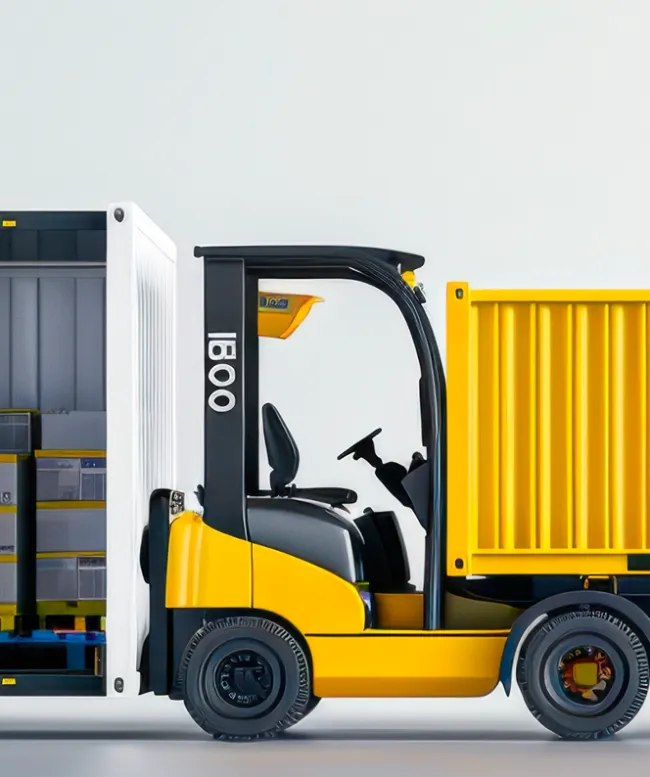
Import Rail Freight Transportation
Rail transportation from the ports of Novorossiysk and Saint Petersburg after vessel discharge and terminal processing is one of the most common methods of delivering cargo (containerized, general, and bulk) to consignees in remote regions of the country.
The largest marine terminals in these cities have developed rail infrastructure, shunting locomotives, and various handling equipment capable of processing a wide range of cargo arriving at the port.
Our company successfully provides haulage from port terminals using all types of rail rolling stock (gondola cars, boxcars, universal/fitting platforms, and heavy-duty transporters), ensuring optimal timelines for cargo haulage from ports and delivery to the final consignee. This is an ideal solution for multimodal transport where rail complements sea delivery.
The service is particularly in demand for companies importing oversized, heavy, and project cargo: rolled metal, equipment, machinery, production lines, etc.
Often, rail transport is the only year-round method of delivering cargo to regions inaccessible by road, such as the Far North, BAM zone, Yakutia, Khabarovsk Krai, and the Far East.
Stages of Transportation
The process consists of the following stages:
-
Receipt of cargo at the port terminal
-
Ordering and delivery of the required type and quantity of rolling stock to the port terminal's rail tracks
-
Cargo preparation before rail shipment
-
Loading, positioning, and securing of cargo on the rolling stock
-
Preparation of shipping and accompanying documents
-
Real-time monitoring and reporting of cargo movement to the client
Estimated rail delivery times:
| Destination | Destination | From Saint Petersburg |
|---|---|---|
| Moscow | 3–7 days | 1–2 days |
| Kazan | 4 days | 3–4 days |
| Yekaterinburg | 5–6 days | 5–10 days |
| Novosibirsk | from 7 days | from 5 days |
Export Rail Freight Transportation
Rail transport is the primary method of delivering export cargo destined for third countries via the country's seaports.
Economic efficiency is achieved by transporting large volumes of products from mining, metallurgical, machinery, petrochemical, timber industry, and pulp and paper enterprises by rail over distances of 1,000 km or more from shippers' warehouses to seaports in Novorossiysk and Saint Petersburg.
Based on shipper requests and in coordination with Russian Railways (RZD) and seaport administrations under the GU-12 plan, BSF supplies all types of rail rolling stock for loading: gondola cars, boxcars, universal/fitting platforms, and transporters for heavy, oversized, and project cargo. We organize container dispatch as part of accelerated trains and form group and bulk wagon shipments.
After cargo delivery to the ports, we unload the rolling stock under surveyor supervision and, until vessel arrival, temporarily store the cargo according to its characteristics. Containers are moved to shipping line depots; general cargo and equipment are placed on open yards, under cover, or in covered terminals; bulk cargo is stacked and separated if necessary. We prepare documents for sea transport.
Upon vessel arrival, we deliver cargo to the vessel's side, load it on board, and arrange sea transport to the destination port according to contract terms.
Organization of Domestic Rail Freight Transportation
We carry out domestic rail freight transportation between raw material bases and production facilities, moving cargo from the terminals of the port of Ust-Luga, the Greater Port of Saint Petersburg, Bronka, and the Novorossiysk Commercial Sea Port across the entire Russian Railways (RZD) network.
Cost of Rail Freight Transportation
The price of rail freight transportation is transparent and depends on several factors. The base rate is formed according to RZD tariffs and depends on the cargo class, distance, cargo weight, and type of rolling stock (wagon/platform).
-
Tariff per 1 ton or per 1 wagon/platform/container;
-
Fee for the use of private rolling stock.
Geography of Transportation
The geography of BSF's rail freight transportation covers the entire RZD network.
The main loading regions for our clients' export cargo destined for third countries via the ports of Saint Petersburg and Novorossiysk are located in the Central, Northwestern, Southern, North Caucasian, Volga, Ural, and Siberian Federal Districts.
Import cargo arriving in the Russian Federation through the ports of Novorossiysk and Saint Petersburg is transported by rail from the marine terminals in these cities to Moscow and beyond — all the way to Vladivostok!
The cost of rail freight per 1 ton of transported cargo is 30–50% lower than road transport for distances of 1,000 kilometers or more.
List of Documents for Rail Freight Transportation
Transporting goods by rail requires a standard package of documents. We will assist with their preparation to avoid delays and downtime. The basic package includes:
-
Railway consignment note
-
Truck consignment note (TTN)
-
Certificates of conformity and quality
-
Transport contract
-
Insurance policy
-
Customs declaration (for imports)
For international shipments, SMGS documents may additionally be required, and for multimodal routes, a CMR may also be needed. BSF will help prepare the entire document package, and our consultation is free of charge.

Our services



Countries we work with

China

Vietnam
Turkey

Egypt

Israel

Syria

UAE

Saudi Arabia

India

Argentina

Pakistan

Brazil

Why customers choose BSF

Exclusive ocean freight rates
Thanks to our long-standing and successful track record in export shipments, we have earned the loyalty of key ocean carriers. This enables our clients to access unique freight rates for export and import flows, saving up to 20–30% compared to base tariffs.

Focus on complex cargo
We work with bulk cargo, full vessel lots, sawn timber, metal ingots, coils, big bags, oversized cargo and containerized shipments. Cargo accumulation and dispatch are handled smoothly, with full processing in Novorossiysk.

Unique stuffing and transshipment solutions
Our core know‑how lies in direct contracts with Novorossiysk ports covering re‑stuffing and transshipment of various cargo types. This ensures fast, safe and cost‑efficient handling for virtually any cargo.

Turnkey end‑to‑end service
From container delivery and removal to customs formalities and documentation, including interaction with FGBU “TsOKZ”, FGBU “VCR”, certification and permits – all processes are managed by a single provider. One contractor means fewer complications for your business.

Expertise in key industries
We have extensive experience working with the agro‑industrial sector, chemical industry, wood processing, mining and metallurgy. Grain logistics in vessel holds is one of our core specializations.

Extensive agents’ network
We maintain close working relationships with shipowners and operators and rely on a global network of agents. Our operations cover the ports of Novorossiysk, Saint Petersburg, Rostov‑on‑Don, Azov, Yeysk, Kavkaz, Astrakhan, Olya, Arkhangelsk and Aktau, with partner companies in Turkey, Jordan and the UAE.
Do you have any questions?
Fill out a short form and our specialists will contact you and answer all your questions.